
Start with the print, not the people in it. What the picture is on, how big it is, the shape of its edges, its border and its color all changed on dates that museums and archives have pinned down. Together they usually narrow a family photo to a decade or two.
Answer the five questions below with the print in your hand. Each answer carries a date range from a museum or archive guide, and the checker shows where they overlap. The ranges are estimates, and they date the print itself: a copy made in 1950 of an 1880s portrait is a 1950 print.
Date your print in five questions
The checker runs in your browser with JavaScript turned on. Every clue it uses, with its dates and sources, is in the table further down this page.
How to read each clue
Measure the print, mount and all. The sizes in the checker are the card's, and the picture glued on it is always smaller.
One clue on its own can span decades. Two or three that agree are far safer, so answer every question you can and mark the rest Not sure. Telling a daguerreotype from an ambrotype or a tintype inside a case is a separate test, done by tilting it under a lamp.
A month and year printed small in the white border, like JUL 58, is the closest thing to a date stamp a snapshot has. It's the month the lab printed the film, so the picture was taken that month or before it.
If your answers point to different times, suspect a copy. When an old portrait was copied onto newer paper, the card, the paper and the tone each tell a different story. Date the copy from the print, and the original from the people and clothes in it.
Every clue, with its dates
Every clue the checker uses is folded below. Where most prints of a kind were made in a shorter span than the full range, the table says so.
Show all 24 clues and their datesWhat it's on, its size, edges, border and color, with the guide behind each range
What it's on
| What you see | Estimated date, and why |
|---|---|
| Glued to stiff card | 1860 or later Card mounts became standard with the carte de visite around 1860. The size of the card narrows it. |
| Thin photo paper with no card | 1888 or later Earlier paper prints were nearly always glued to card. Loose prints belong to the snapshot years, which began with Kodak's first camera in 1888. |
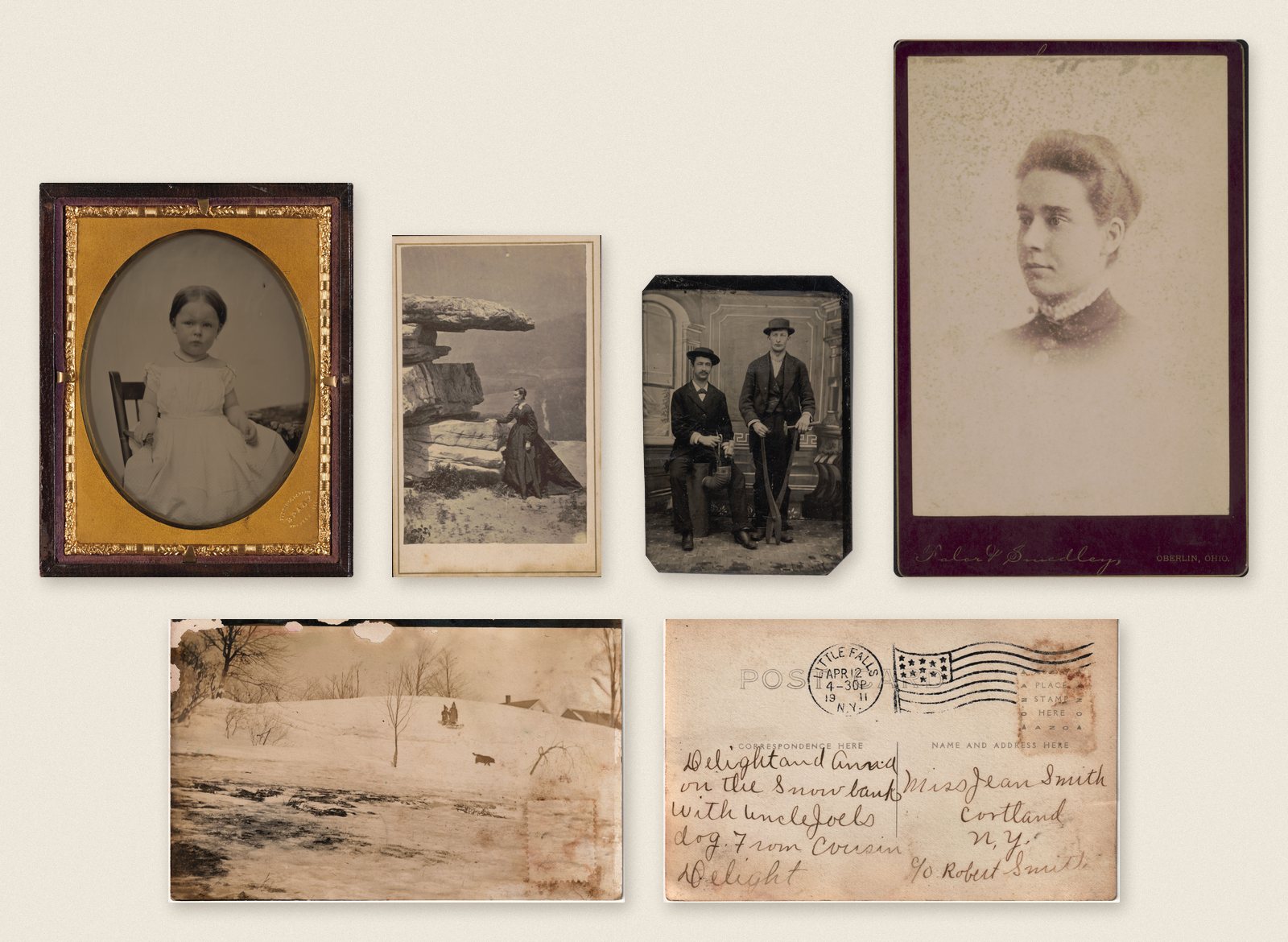
 A thin, dark metal plate | 1856 to 1939 Likely a tintype. Tintypes were patented in 1856, were most popular during the Civil War, and were made into the 1930s, so the plate alone gives a wide range. |
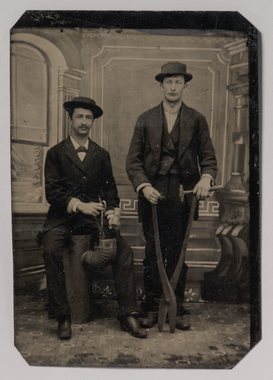
 A small hinged case with glass over the picture | 1840 to 1889, most in the 1840s to the 1860s Likely a cased image: a daguerreotype, an ambrotype or an early tintype. Daguerreotypes (1839 to the 1860s) and ambrotypes (from about 1854 into the 1880s) came in hinged cases, as did some tintypes. Most cased pictures date from before 1870. Molded "Union" cases, an early plastic, were made from 1855 to 1865. |
| A thin, glossy instant print that was peeled apart | 1948 or later Likely a peel-apart instant print. Polaroid's first instant camera came out in 1948. |
| An instant print with a wider white strip at the bottom | 1972 or later Likely a one-piece instant print. Prints that came out of the camera whole and developed on their own began with Polaroid's SX-70 in 1972. |
Its size
| What you see | Estimated date, and why |
|---|---|
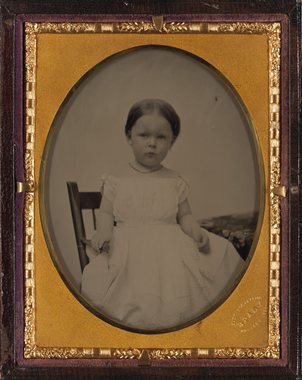
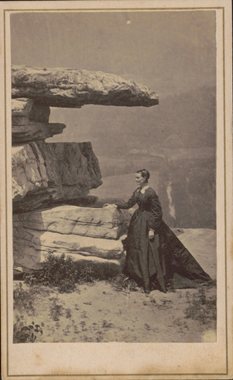 A card about 2½ × 4 in | 1860 to 1910, most in the 1860s Likely a carte de visite. Cartes de visite caught on around 1860 and were made until about 1910. Most date from the 1860s. George Eastman Museum, Science and Media Museum, Ohio Memory |
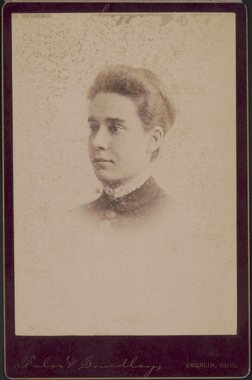 A card about 4¼ × 6½ in | 1866 to 1918, most in the 1870s to the 1890s Likely a cabinet card. Cabinet cards reached the US in 1866, caught on in the 1870s, were the favorite format in the 1880s and 1890s, and had mostly gone by the end of World War I. Ohio Memory, George Eastman Museum, Science and Media Museum, Graphics Atlas |
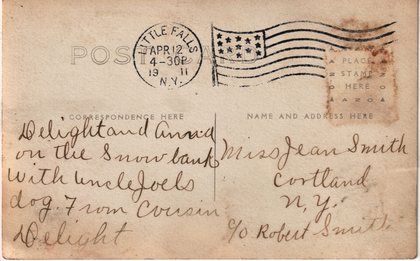 A photo about 3½ × 5½ in with a printed postcard back | 1903 to 1959, most 1907 to 1930 Likely a photo postcard. Kodak's postcard camera came out in 1903. Photo postcards were most popular from 1907 to about 1930, and some were made until the middle of the century. |
| A square snapshot, about 3 to 3½ in | 1930 or later, most in the 1950s to the 1970s Square snapshots this size turn up from the 1930s and were most common from the 1950s to the 1970s, when Kodak's Instamatic cameras (from 1963) took square pictures. |
| A print about 4 × 6 or 3½ × 5 in | No date on its own Size alone doesn't date a print this size, and no museum guide gives a start year for it. Its border and color say more. |
Its edges and corners
| What you see | Estimated date, and why |
|---|---|
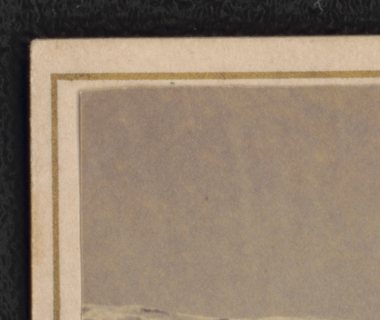 A carte de visite with square corners | 1860 to 1879 Carte mounts of the 1860s usually had square corners. Rounded corners began to appear in the 1870s. |
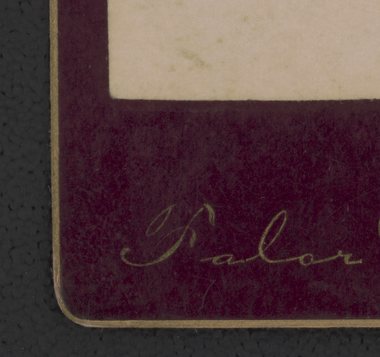 A card mount with rounded corners | 1870 or later Rounded corners on card mounts began to appear in the 1870s. |
| A card mount with a wavy or scalloped edge | 1890 to 1939 Scalloped edges turn up on cabinet cards of the 1890s. Studios sold portrait folders with deckle edges through the 1920s and 1930s. |
| A snapshot with wavy, deckle-cut edges | 1930 to 1969, most in the 1940s to the 1950s Likely a deckle-edged snapshot. A study of 321 dated snapshots found wavy edges from 1930 to 1967, most of them from the 1940s and 1950s. It's the one large study, so take this range as a guide. |
| A snapshot with rounded corners | No date on its own Rounded corners turn up on snapshots from the 1930s through the 1960s, so on their own they don't narrow it. |
Its border
| What you see | Estimated date, and why |
|---|---|
| A month and year printed in the white border | 1937 to 1979 A few labs printed the date in the border by the late 1930s. It was common from the early 1950s, and on color prints from 1960, until borderless prints took over in the 1970s. |
| A color print with a white border | 1942 or later, most 1942 to 1979 Most color prints had a white border until labs switched to borderless prints during the 1970s. |
| A color print with no border | 1968 or later Borderless color prints came with resin-coated paper, from 1968, and most prints of the 1970s had no border. |
Its color
| What you see | Estimated date, and why |
|---|---|
| Neutral black and gray, with no brown | 1873 or later, most in the 1890s or later Neutral black-and-white prints go back to the 1870s, but most were made in the 1890s or later. Earlier paper prints are brown or purple-brown. |
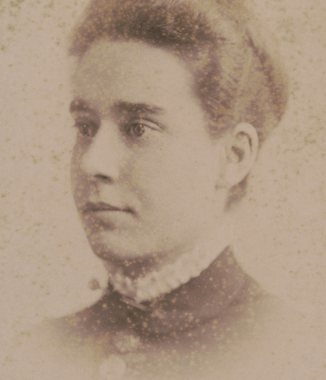 Brown or purple-brown | 1850 or later, most in the 1850s to the 1930s Most paper prints from the 1850s to the 1890s are brown or purple-brown, and brown-toned prints stayed common into the 1930s. A faded black-and-white print can turn yellow-brown too. |
| Color that has gone orange, red or pink | 1942 or later, most 1942 to 1979 Color prints began in 1942. Prints made before about 1980 often shift toward red or magenta. Later ones hold their color far better, unless they sat in strong light. |
| Color that still looks natural | 1942 or later Color prints began in 1942. Many made before 1980 have shifted, but prints from the 1960s often held up well, so this alone sets only the start. |
| An instant print in color | 1963 or later Color instant prints came out in 1963. |
The photos in this table are details of the archive pieces at the top of the page. The rest are drawings.
More clues on the back and in the picture
Turn the print over. A studio's name and street address, printed on the mount, can be looked up in old city directories, which show the years that studio stood at that address. Handwriting on the back, a name or a year, can settle it, as long as it agrees with the print.
The back of the photo postcard at the top of this page holds three clues at once: the printed postcard lines, a postmark of April 12, 1911, and a note naming the two girls on the snowbank.
The picture itself narrows it further once you know the decade. Clothes and hair change every few years, and a uniform has its own details to read, set out in our guide to military uniforms in old photos. A baby held up by a draped shape on a tintype or cabinet card is a hidden mother portrait, a studio habit of the same years.
A black-and-white snapshot from the 1950s isn't a mistake in the checker: color cost more for years after it arrived, as why old photos are black and white explains. If you might sell an old card, find out what it's worth before you clean or trim it.
Scan the print edge to edge, and its back, before you restore it
Knowing when a print was made is the first step in knowing what you have, and the clues sit at its edges and on its back. A crop or a cleanup removes exactly those.
So scan the print edge to edge with a little background showing, scan the back as well, and keep both files as your record. Our guide to scanning at home covers the settings. Then restore a copy and keep the scan as it is.
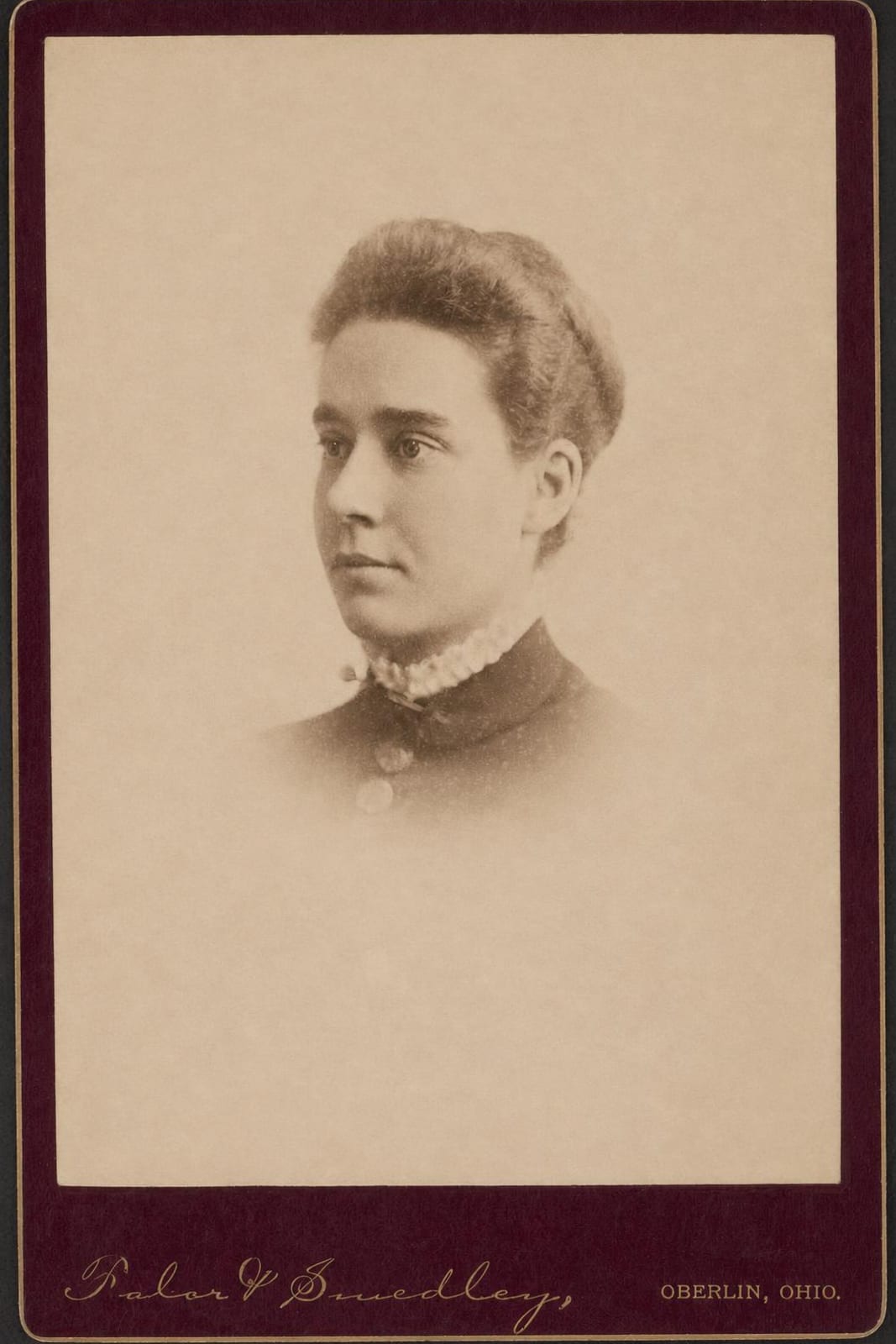
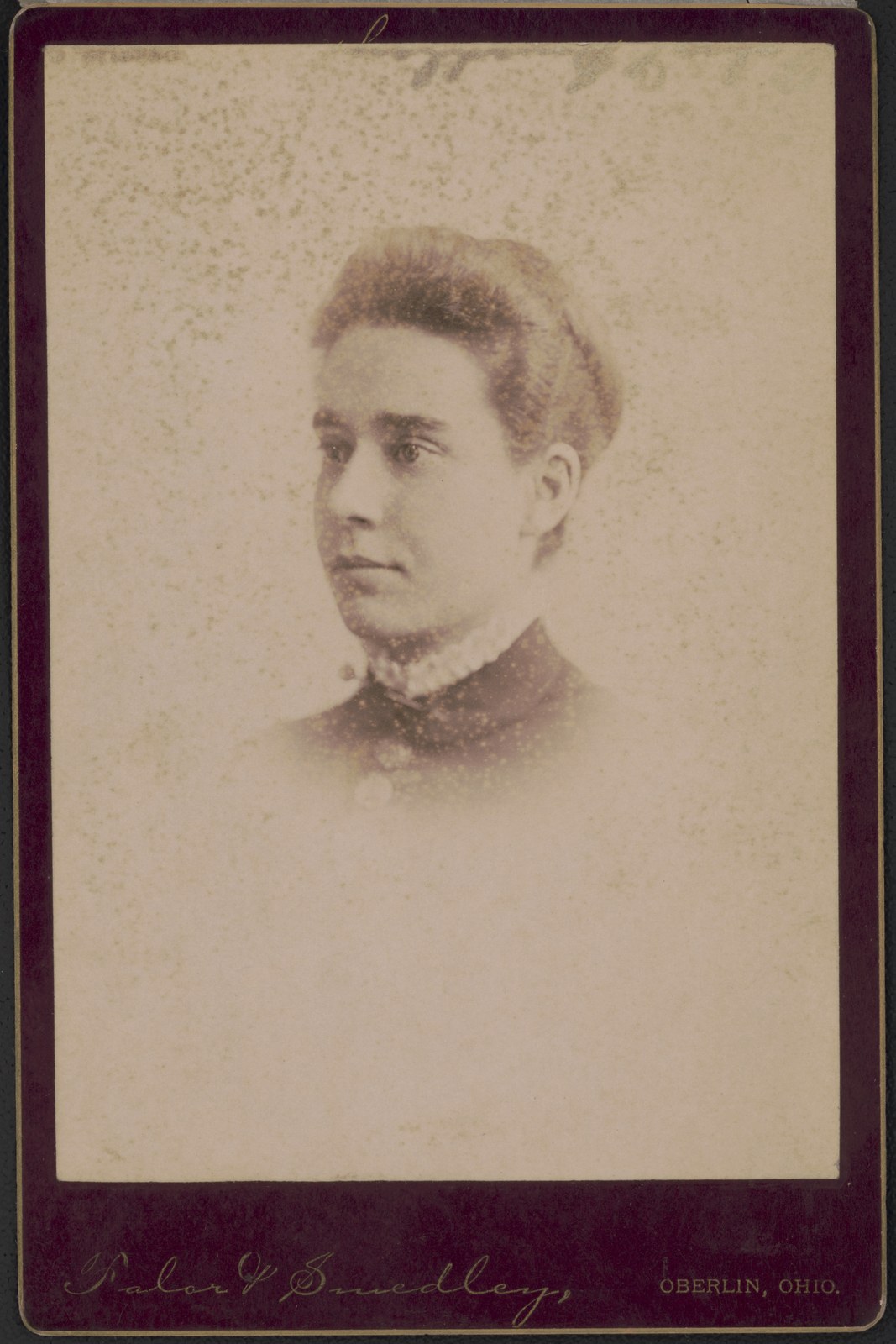
Drag the line to compare the scan with the restore.
Here the foxing went, and the clues that date the card came through: the dark mount, the gilt studio name, the rounded corners and the brown tone. The faint writing along the top edge did not. On your own print, read writing and dates from the scan, and check the face in the restore against the original.
Restore a copy of yours and check that its clues came through: 2 free watermarked previews a day, no card needed, about a minute each.
- 01Scan the front edge to edge, with a little background around it, then scan the back.
- 02Answer the five questions with the print in your hand, and mark Not sure rather than guess.
- 03Read the back: the studio's name and town, any writing, any postmark.
- 04Write the estimate and its reasons on the photo's sleeve or in the file name.
- 05Restore a copy, and keep the scan as the record.
Sources for the dates on this page
- Image Permanence Institute, Rochester Institute of Technology. Graphics Atlas: Albumen, object view.
- George Eastman Museum. Carte de Visites and Cabinet Cards (collection album).
- Eastman Kodak. Company milestones.
- Image Permanence Institute, Rochester Institute of Technology. Graphics Atlas guided tour: Civil War era tintype.
- Preservation Self-Assessment Program, University of Illinois. Daguerreotypes, Ambrotypes, and Tintypes.
- Image Permanence Institute, Rochester Institute of Technology. Graphics Atlas: Daguerreotype, object view.
- Science Museum Group collection. Polaroid Land Camera Model 95, 1948 to 1953, the first of Polaroid's instant picture cameras.
- Preservation Self-Assessment Program, University of Illinois. Photographic prints: identification guide.
- Cooper Hewitt, Smithsonian Design Museum. SX-70 Camera and Case, 1972.
- NPR. How the 1972 Polaroid SX-70 revolutionized consumer photography, August 2, 2026.
- National Science and Media Museum. How to spot a carte de visite (late 1850s to c.1910).
- Ohio Memory (Ohio History Connection and State Library of Ohio). Exploring Old Photographs: Cartes de Visite, 2023.
- Ohio Memory (Ohio History Connection and State Library of Ohio). Exploring Old Photographs: Cabinet Cards, 2024.
- National Science and Media Museum. How to spot a cabinet card (1866 to c.1914).
- Ohio Memory (Ohio History Connection and State Library of Ohio). Exploring Old Photographs: Real Photo Postcards, 2024.
- Smithsonian Institution Archives. Postcard History.
- Anna Krentz. Snapshots with an Edge: A Study of the Deckle Edge in the North American Snapshot. MA thesis, Ryerson University (now Toronto Metropolitan University), 2014. A study of 321 dated snapshots and Kodak trade journals.
- Science Museum Group collection. Kodak Instamatic 500 camera, 1963 to 1965, for 126 cartridge film, 28 x 28 mm.
- Image Permanence Institute, Rochester Institute of Technology. Graphics Atlas: Chromogenic, object view.
- John Wolbarst. Review of Polacolor instant color film. Modern Photography, March 1963 (reprinted by Mike Eckman).